Answer Engine Optimization
Answer engine optimization: writing content AI systems actually quote
AEO tools and technique for getting cited when ChatGPT, Perplexity, and voice assistants answer a question about your category.
What makes content quotable
Answer engines favor content that states its answer immediately and specifically (a real number, a named comparison, a concrete recommendation) rather than content that works up to the point slowly. The same discipline that makes a page easy for a human to skim tends to make it easy for an AI system to extract and cite.
How Peakfai builds for AEO
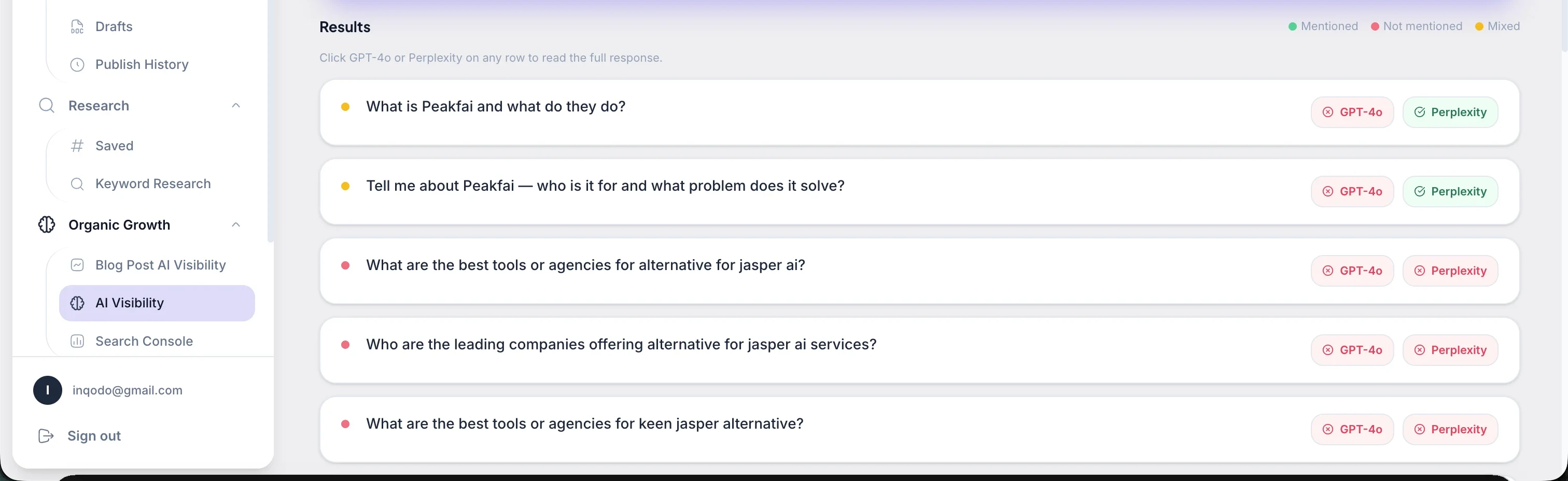
Every post starts from a real buyer question, answers it directly in the first few sentences, and backs the claim with specifics rather than filler. Peakfai then tests the result against GPT-4o and Perplexity using the same questions your buyers actually ask, so you know whether the content is working — not just whether it's published.
A simple test for any page you're publishing
Read only the first two sentences of the page and ask: could someone lift this and quote it as a complete answer to the title question? If the first two sentences are throat-clearing ("in today's competitive landscape," "there are many things to consider") the answer is no, and an AI system will likely skip past it to a source that passes the test.
This is a genuinely useful gut-check for reviewing your own content, whether or not you use any specific tool to automate the writing — the discipline matters more than the tooling.
Related reading
Frequently asked questions
The best AEO tools test your visibility against real AI-generated answers rather than relying on proxy metrics. Peakfai runs your actual buyer questions through GPT-4o and Perplexity, records whether and how your brand is cited, and turns the gaps directly into scheduled content, so the tool doesn't just report the problem, it fixes it.
SEO optimizes for ranking in a list of search results a person then clicks through. AEO (answer engine optimization) optimizes for being the source an AI system cites or quotes when it generates one direct answer instead of a list of links. The content fundamentals overlap (real expertise, clear writing, genuine usefulness) but AEO rewards direct, specific, self-contained answers more heavily than SEO's ranking signals do.
Most answer engines retrieve a handful of candidate sources for a query and select the ones that state the answer most directly and specifically, often preferring content structured as a clear question followed by a concise, factual answer. Long, unstructured pages that bury the answer in paragraph four rarely get selected, regardless of their Google ranking.
It requires a different opening, not necessarily a different topic. A post can rank well in Google and still perform poorly for AEO if the direct answer is buried under three paragraphs of preamble. Leading with the answer, then expanding into detail, tends to satisfy both AEO and the reader who wants the answer fast.
Take "how much does SEO content cost." A weak opening says "There are many factors that go into SEO pricing." A strong one says "Most small businesses pay $500-3,000/month for SEO content, depending on volume and whether it includes strategy." Same topic, same eventual nuance later in the page, but only the second version gives an answer engine something to quote.
Yes, more than most page formats: a well-written FAQ is already structured as a direct question paired with a direct answer, which is exactly the shape answer engines are built to extract. It's a large part of why every page on this site carries its own FAQ section with real, specific answers rather than a generic shared one.